
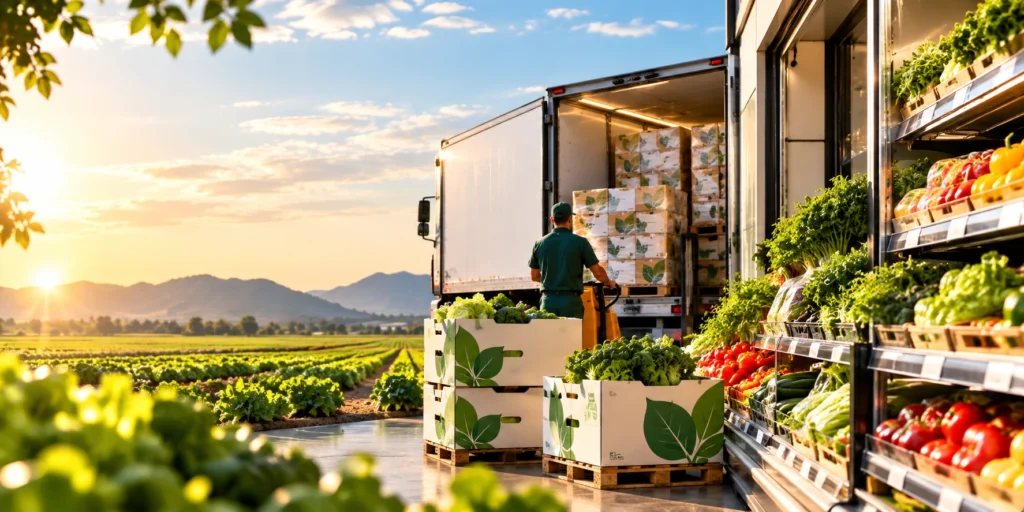
Why can a shipment of fresh fruit arrive in good condition and still lead to a shelf-life claim a few days later? In many cases, the answer is not a single incident but the sum of everything that happened from harvest to storage and distribution at destination.
The shelf life of fruit and vegetables depends on many factors: variety, ripeness, growing conditions, handling, pre-cooling, transport and the buyer’s stock management.
At Frubalmed we have been exporting fresh fruit and vegetables for ten years. Experience has taught us that shelf-life claims are especially hard to analyse because, by the time the problem appears, the product has already gone through several stages and we do not always have complete information about all of them.
In this article we look at the three stages worth reviewing —production, transport and storage at destination— and at how sharing information between the players in the chain can help identify causes and reduce future claims.
What affects the shelf life of fruit and vegetables?
Shelf life is the period during which a product keeps a quality suitable for sale or consumption, according to the criteria that apply to each product.
In fresh fruit and vegetables, that period depends on the interaction of several factors:
- Production and harvest: variety, ripeness, weather conditions and crop health.
- Post-harvest handling: physical damage, sorting, packing and cooling speed.
- Cold chain: product temperature, continuity of refrigeration and duration of loading and unloading.
- Transport: pre-cooling, air circulation, journey time and compatibility between products.
- Storage at destination: temperature, stock rotation, dwell time and distribution conditions.
The Food and Agriculture Organization of the United Nations (FAO) explains the importance of pre-cooling and of reducing the time products are exposed to high temperatures. These practices help slow deterioration and preserve post-harvest quality.
So when a claim for insufficient shelf life arises, it is worth analysing the goods’ entire journey before blaming a single stage.
1. Production: know the product before you buy it
One of the first questions buyers and sellers should ask is whether we know the expected shelf life of each product and how its growing and ripening characteristics affect it.
Growers usually know their farm well, how the crop has developed and the conditions the fruit has been through. On the commercial side, however, attention often focuses on immediate aspects such as size, appearance, packaging and price. Some of the agronomic information that could help predict final quality does not always reach the rest of the chain.
Sharing it before harvest can improve purchase planning and storage expectations.
Citrus: external colour does not always reflect internal ripeness
Citrus fruit is a good example of why it pays to know the particularities of each product. Unlike climacteric fruit, citrus does not undergo an equivalent ripening process after harvest.
In addition, peel colour alone does not always reflect internal ripeness. Under certain conditions, a citrus fruit can look greenish even though its internal development is suitable for sale.
To achieve the required commercial colour, degreening may be used: a post-harvest treatment that encourages the breakdown of chlorophyll in the peel. This process changes the external colour, but it should not be confused with an automatic improvement in internal ripeness or shelf life.
That is why, when working with citrus, it is worth knowing the condition of the product and, where relevant, asking the supplier whether degreening has been carried out and under what conditions.
Strawberries: weather and humidity matter too
Strawberries are highly perishable and sensitive to handling conditions. Temperature, humidity, firmness and fruit health all influence how well they keep after harvest.
Warm spells can speed up metabolic processes, while high humidity and damaged fruit can encourage fungal decay problems such as Botrytis cinerea.
So, to anticipate changes in a shipment’s availability and quality, it can help to know the weather in the days before picking and to ask the grower about points such as:
- Have there been high temperatures?
- Have cloudy or sunny days prevailed?
- Has humidity stayed high for long periods?
- Has there been persistent dew or fog?
- Have any crop health problems been observed?
These questions cannot predict a shipment’s shelf life on their own, but they provide context for interpreting its condition and planning sales better.
The UC Davis strawberry fact sheet describes its main quality indices, storage conditions and post-harvest problems. It also stresses the importance of cooling the fruit quickly and avoiding physical damage.
What information should be shared with the buyer?
Beyond the usual commercial parameters, it is useful to record and share relevant information about the harvest and the condition of the product.
Depending on the species and the characteristics of each shipment, this may include:
- Harvest date.
- Variety and ripeness.
- Relevant conditions observed during growing.
- Crop health issues or damage detected.
- Post-harvest treatments applied, where relevant.
- Planned storage conditions.
The aim is not to collect data for its own sake, but to have the information needed to assess expected quality and make realistic commercial decisions.
2. Transport: why setting a temperature is not enough
The cold chain is one of the factors with the greatest influence on how well fresh fruit and vegetables keep. However, specifying a transport temperature does not by itself guarantee that the product will arrive in the right condition.
To protect shelf life, pre-cooling, air circulation and the performance of the refrigeration unit also need to be checked.
What is pre-cooling and why does it matter?
Pre-cooling means quickly removing the field heat the product retains after harvest, before it is stored or transported.
If the goods are loaded at a temperature above the recommended one, the trailer’s refrigeration unit may not be designed to bring down the temperature of the whole load effectively. Its main job is to maintain the planned conditions during transport, not to replace a proper prior cooling process.
So, before loading, it is worth checking:
- Has the product been pre-cooled?
- What is the actual temperature of the goods?
- Has the vehicle been prepared for the journey?
- Are suitable conditions maintained during loading and unloading?
The FAO explains the role of pre-cooling in the cold chain and how reducing exposure to high temperatures helps preserve quality.
In Spain, Royal Decree 2483/1986, available in the BOE (Spanish Official Gazette), sets out provisions on the road transport of food at controlled temperatures, including matters relating to loading, air circulation and pre-cooling of vehicles. Its applicability should be assessed alongside current legislation and the specific requirements of each product and operation.
Why is a lower transport temperature not always better?
Each product has its own recommended storage conditions. Lowering the temperature without considering its sensitivity can cause chilling injury in certain fruit and vegetables.
Aubergines, courgettes and tomatoes are examples of products that can be damaged if kept below the temperatures they tolerate.
The temperature should therefore be set according to the species, variety, ripeness, journey time and expected conditions at destination. There is no single temperature that suits all fruit and vegetables.
Ventilation and air circulation during transport
Air circulation helps keep the temperature right throughout the load. Stowage that restricts airflow can create differences between areas of the trailer.
Ethylene production and the sensitivity of the products being shipped should also be taken into account. Some fruit, such as apples, can produce significant amounts of ethylene at certain stages of ripeness, while some vegetables are sensitive to this gas.
So when loads are shared, product compatibility, temperature needs and required ventilation must be assessed.
Before booking transport, we recommend agreeing storage conditions with the logistics provider, checking the condition of the goods at loading and defining how incidents during the journey will be recorded.
Choosing specialised hauliers and having verifiable cold-chain information makes it easier to identify problems and helps protect the shelf life available at destination.
3. Customer storage: what happens after delivery
Delivery is not the end of the fruit’s journey. The days the goods spend in the buyer’s facilities, the storage temperature, stock rotation and onward distribution also determine how much shelf life is left when the product reaches the consumer.
On the sales side, it is easy to focus on the order arriving correctly and pay less attention to what happens next. Yet to analyse a claim, it is important to know how the goods are handled once received.
How does stock affect shelf life?
In our experience, we have seen fewer claims from some customers who work with low stock levels than from those who hold stock for several days.
This observation does not prove that stock volume directly causes claims. There may also be differences in delivery frequency, product type, rotation, storage conditions or the criteria used to make claims.
Stock should therefore be analysed as one more variable in the process, not as an automatic explanation of the problem.
To better understand the customer’s operation, it is worth asking questions such as:
- How many days of stock do you usually hold?
- At what temperature is each product stored?
- Are cold rooms or storage areas separated according to product needs?
- What quality checks are carried out on receipt and during storage?
- How long does it take from receipt to sale?
- How much shelf life does the product need to have left when it reaches the end consumer?
These answers help match quantities and supply frequency to real demand, always bearing in mind the characteristics of each product.
Customer information is also part of traceability
To investigate a claim, it is important to have data from the different stages: production, transport, receipt and storage.
Recording temperatures, relevant dates and times, the condition of the goods and any incidents detected makes it easier to reconstruct the product’s journey.
Information shared between supplier, exporter, haulier and buyer can help identify where quality was lost and what measures should be taken for future deliveries.
How to investigate a shelf-life claim
When a customer reports that a shipment has lasted less than expected, it is worth gathering information before blaming a single cause.
The process can be organised in five steps:
1. Review the product at origin. Check the variety, ripeness, harvest date and any known incidents during production.
2. Check how the goods were prepared. Review handling conditions, pre-cooling and product temperature before loading.
3. Reconstruct the transport. Look at journey time, available temperature records, incidents and loading and unloading conditions.
4. Analyse receipt and storage. Review the condition of the product on arrival, the time elapsed until inspection, storage conditions and stock rotation.
5. Compare the data and agree improvements. Cross-check information from the different stages to identify the most likely causes and put corrective measures in place.
This procedure does not guarantee that a single cause will always be found. Its value lies in replacing assumptions with verifiable information and making shared decisions easier.
How to reduce shelf-life claims when exporting fresh fruit
Reducing claims requires coordination between everyone in the chain. Producing quality fruit is not enough: it must also be stored, transported and distributed in a way that suits the needs of the product and the customer.
These are some measures that can help:
- Choose suitable varieties: consider expected shelf life and journey time when choosing the product.
- Match quantities to expected consumption: avoid supplying more than the customer really needs.
- Shorten transit times where feasible: look at logistics alternatives that preserve more shelf life at destination.
- Control pre-cooling and the cold chain: record relevant parameters and incidents.
- Share information between supplier and buyer: document the condition of the goods and the conditions at each stage.
- Adapt specifications to each customer: agree ripeness, delivery conditions and the shelf life the product needs to retain at destination.
The feasibility of each measure depends on the product, origin, logistics route and commercial operation. That is why it is important to assess each shipment individually.
Frequently asked questions about the shelf life of fruit and vegetables
What determines the shelf life of fresh fruit and vegetables?
Shelf life depends on variety, ripeness, growing conditions, post-harvest handling, temperature, transport and storage. The importance of each factor varies by product.
How does the cold chain affect fruit shelf life?
A well-managed cold chain helps slow the deterioration of many fresh products. To work properly, the right storage conditions must be applied from harvest and maintained throughout transport and storage.
What is the difference between pre-cooling and refrigeration during transport?
Pre-cooling removes the heat the product retains after harvest. Refrigeration during transport maintains the planned temperature conditions throughout the journey. A refrigeration unit should not be seen as a substitute for pre-cooling where pre-cooling is needed.
Why can fruit arrive in good condition and then deteriorate quickly?
Its appearance at delivery does not always reflect the product’s full history or its remaining shelf life. Ripeness, internal damage, transport conditions and subsequent storage can all influence deterioration.
How can a shelf-life claim be investigated?
Information on production, harvest, handling, pre-cooling, transport, receipt and storage needs to be reviewed. The more verifiable data the parties share, the better the chances of identifying the factors that contributed to the problem.
Does holding more stock increase claims?
Not necessarily. Holding stock for longer can reduce the shelf life available before sale, but claims also depend on rotation, temperature, product type and other factors. The relationship should be analysed with data from each operation.
Conclusion: shelf life is protected throughout the chain
Growing an excellent product is only the first step. A claim for insufficient shelf life may reflect a combination of factors that built up during production, transport and storage.
So rather than looking for a single culprit, it is important to reconstruct the product’s journey with information from each stage. Sharing data on harvest, pre-cooling, cold chain and stock management helps make sense of incidents and define realistic improvements.
At Frubalmed we work to connect production, transport and buyer needs through transparent communication. Sometimes the analysis leads us to conclude that a product will not arrive with enough shelf life for the planned operation. At other times, it helps us find alternatives: shortening transit days, choosing more suitable varieties, adjusting quantities or adapting delivery frequency.
The goal is for every shipment to meet the customer’s needs and keep the required quality for as long as possible.
Looking for a fresh fruit and vegetable supplier that takes into account the shelf life, origin and logistics of your business? Contact Frubalmed to discuss the needs of your next operation.